
Arrest Records in Marion County
Arrest records in Marion County are created by law enforcement at booking. The Marion County Sheriff's Office, led by Sheriff Kerry J. Forestal, runs the county jail and the public inmate lookup. When the Indianapolis Metropolitan Police Department or another agency makes an arrest, the person is taken to the county adult detention operation for intake. That intake builds the arrest and booking record: identity, charges, booking number, and date.
An arrest record is not the same as a criminal court record or a conviction record. The arrest record reflects a booking. The court record begins when the prosecutor files charges and a case opens. The conviction record only exists if the case ends in a plea or verdict of guilt. Full case history lives on the Marion County court records page; arrest and custody data sit with the sheriff.
Marion County and Indianapolis share one government, branded as the city's digital hall. A visit to the Indy.gov county hub lists the elected sheriff, prosecutor, and clerk who each touch a criminal case.

That unified site is why a Marion County arrest search can bounce between sheriff, court, and clerk pages.
How to Search Marion County Arrest Records
The fastest local check is the Marion County inmate lookup at inmateinfo.indy.gov/IML, which shows people currently in custody. For the case that follows an arrest, use Indiana MyCase. For agency records like reports, the county runs an online public-record request system.
- Open the Marion County inmate lookup to check current custody by name or identifier.
- Search Indiana MyCase for the criminal case once charges are filed.
- Review the charges, bond, and hearing events in the case summary.
- Request a report or agency record through the county public-record system if needed.
For records held by a city or county agency rather than the court, the request goes through the official portal. The Indy.gov public-record request page handles those agency requests.
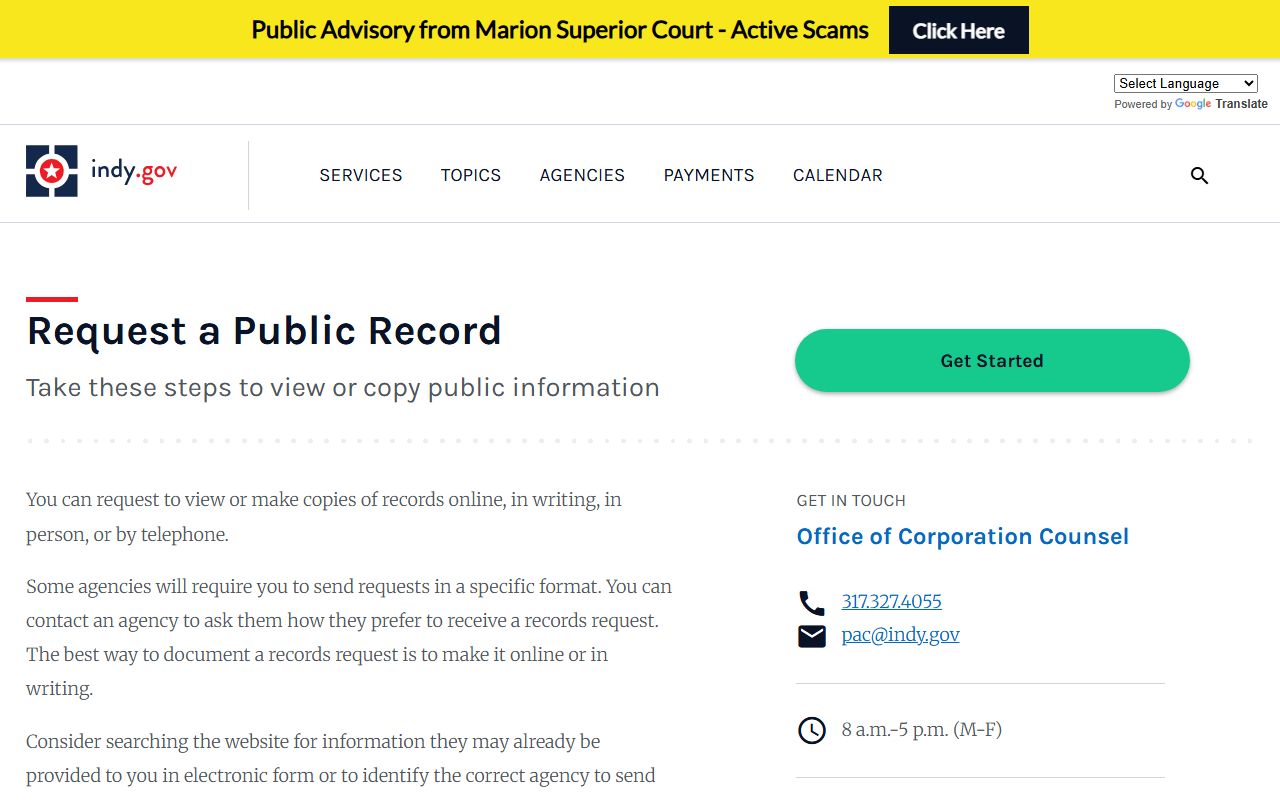
Use that system when you need a document the courts do not hold, such as an agency report.
Arrest Records vs. Criminal Court Records
An arrest record is built at booking by the sheriff or arresting agency. A criminal court record is built by the clerk once the prosecutor files charges. The two often describe the same event, but they live in different systems and serve different needs.
| Arrest Record | Criminal Court Record | |
|---|---|---|
| Source | Sheriff / arresting police agency | Marion County Clerk and courts |
| Created When | At booking and intake | When charges are filed |
| Contents | Booking number, charges at intake, bond, custody status | Charges, pleadings, hearings, disposition, sentence |
Not every arrest leads to a filed charge, and not every charge leads to a conviction. That is why you check both the inmate lookup and MyCase.
Charges vs. Convictions
A charge is an accusation. A conviction is a finding of guilt by plea or verdict. The Marion County Prosecutor, currently Ryan Mears, represents the State of Indiana and files charges in criminal cases. The office reports that about 24,000 criminal cases are resolved in the county each year, so most arrests move into the court system in some form.
| Charge | Conviction | |
|---|---|---|
| Stage | Accusation by the prosecutor | Plea or verdict of guilt |
| Burden of Proof | Probable cause | Beyond a reasonable doubt |
| Public Record | Yes, in the case file | Yes, with sentence terms |
The prosecutor's role and caseload are detailed in the county budget. A read of the 2024 adopted budget describes the Trial Division teams for major felony, Level 6 felony, special victims, and narcotics work.
That budget shows how charges are routed to specialist teams before a case reaches a courtroom.
Sealed vs. Expunged Records
Indiana lets eligible people clear certain criminal records. Sealing restricts public access. Expungement under state law can remove a case from public access entirely depending on the type. Both follow waiting periods and strict steps under the expungement statute.
| Sealed | Expunged | |
|---|---|---|
| Visibility | Hidden from public view | Removed from public access |
| Law Enforcement | Limited access remains | Very limited access remains |
| Eligibility | Set by case type and waiting period | Differs for arrests without conviction, misdemeanors, and felony levels |
The rules sit in one chapter of the Indiana Code. A look at Indiana Code § 35-38-9 sets out who qualifies and how the process works. A granted expungement can pull a case out of MyCase, so a missing case is not proof none ever existed.
The Marion County Booking Process
Booking is what turns an arrest into a record. After an arrest, the agency transports the person to the county adult detention intake. Intake follows a set order, and each step adds data to the arrest record. The bond decision and the first court date then tie the arrest to a case that can appear in MyCase.
- Identity check and entry of booking data.
- Property inventory and photograph or fingerprints.
- Medical and mental-health screening.
- Classification and housing assignment.
- Initial court and bond processing.
Public users should confirm live custody through the official county inmate lookup rather than relying on screenshots or third-party rosters. Initial hearings and bond decisions show up in the court case, so a new booking often produces a fresh MyCase entry within days.
Mugshots and Booking Photos
Booking photos may be part of an arrest record, but Marion County's live public profile display was not confirmed in official sources, so do not assume a photo will always appear. Check the official county inmate lookup rather than third-party mugshot sites, which often charge fees and are not authoritative. If a booking photo is a public record, the sheriff's office or the public-record request process is the proper source.
Statewide Criminal Records Search
For court case history, Indiana MyCase reaches the trial courts statewide, so a person's filed cases across Indiana can surface there. A formal statewide criminal background check, however, is a separate process handled by the Indiana State Police limited criminal history repository, not by the county court portal. The court record shows the case; the state repository compiles the criminal history.
For records the courts do not hold, the county public-defender and prosecutor offices are funded and described in county budgets. A read of the 2023 adopted budget lists the Public Defender Agency funding that supports indigent defense.
The Public Defender Agency board and meetings are posted on the county site for those who need appointed counsel.
Background Check Considerations
There is a real difference between a casual record lookup and a formal background check. A casual search on MyCase or the inmate lookup is fine for personal awareness. A background check used for hiring, housing, or credit must follow the federal Fair Credit Reporting Act and use a compliant consumer reporting agency. The county prosecutor and public defender offices both touch these cases, and the agency descriptions are public.
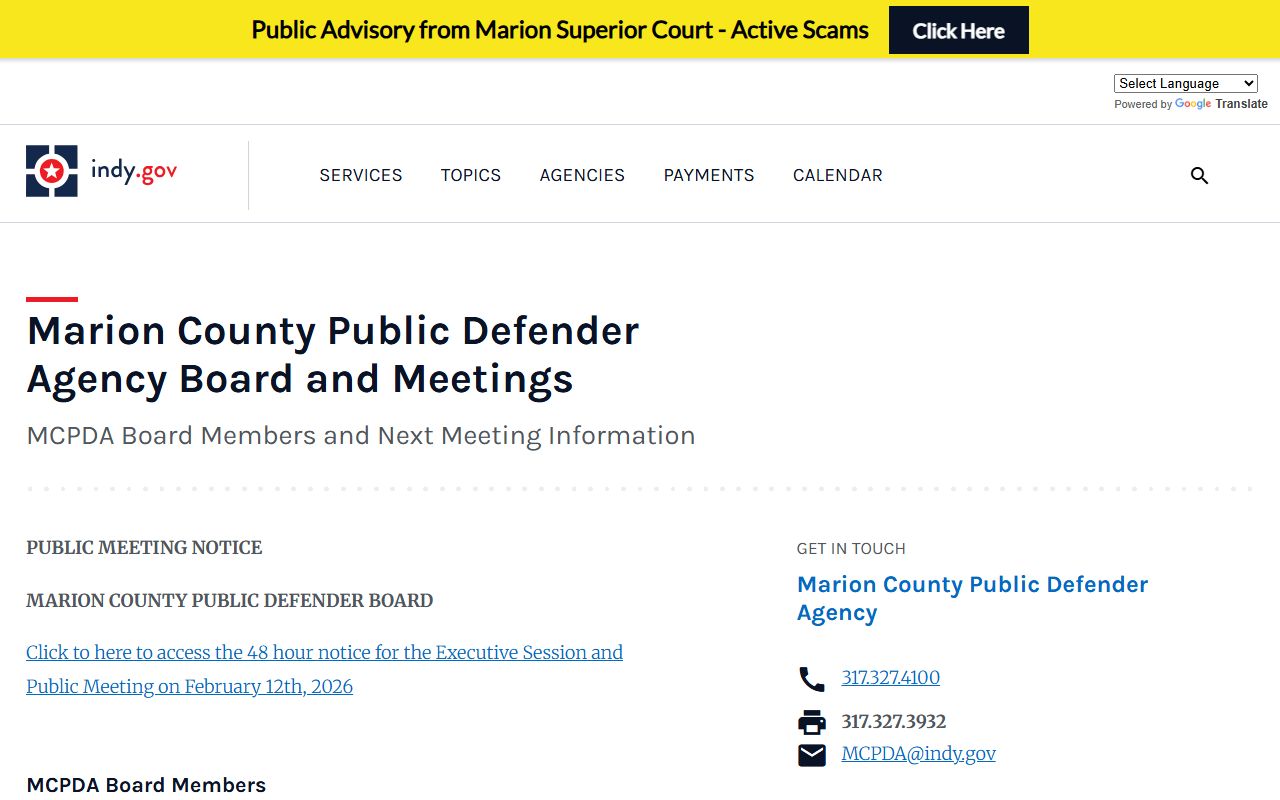
The Public Defender Agency board page explains how appointed defense works for eligible defendants.
Important: This site is not a consumer reporting agency under the FCRA, and its information cannot be used for credit, employment, tenant, or insurance decisions.
Restricted Criminal Records in Marion County
Some criminal records are not open to the public. Juvenile delinquency records are restricted under Indiana juvenile law. Sealed cases and granted expungements are kept off public access. Active investigation materials and grand jury records are also not ordinary public docket items. The clerk maintains the official files, and certified copies of public criminal records come from the clerk's office.
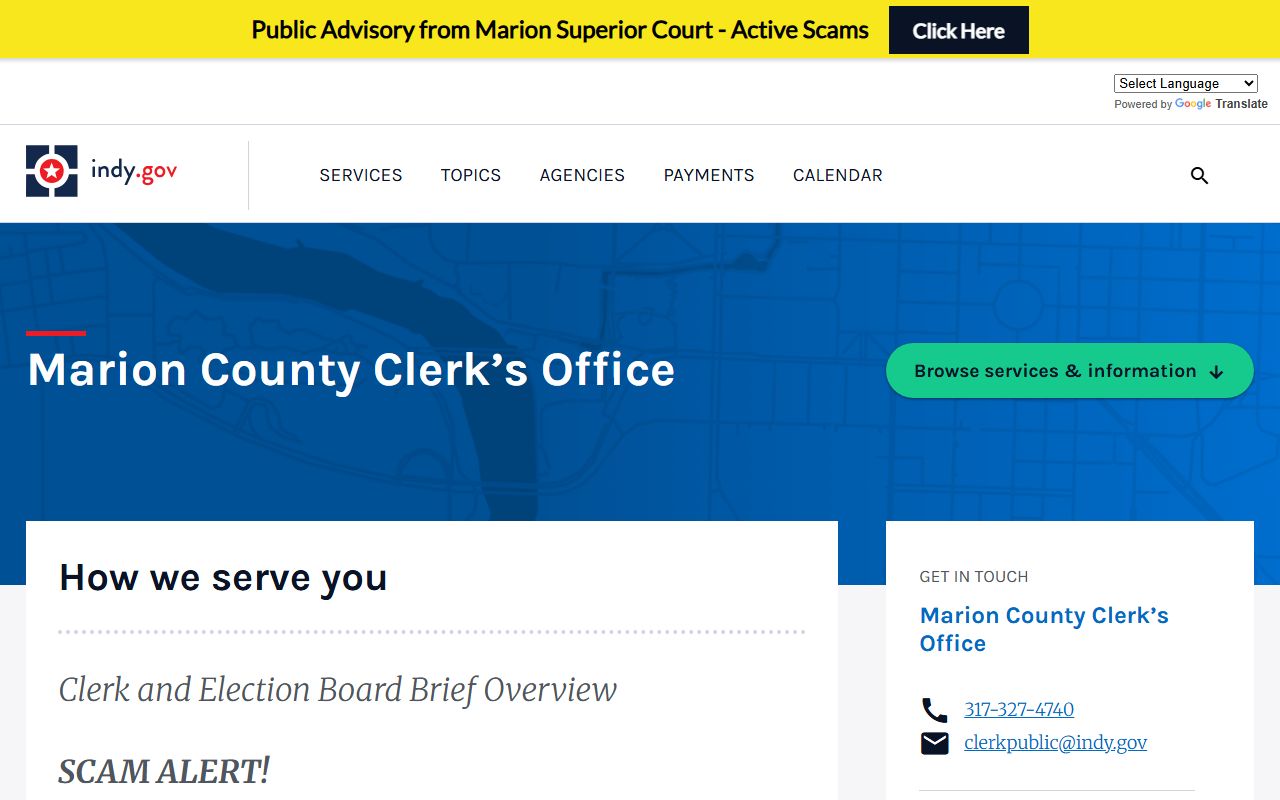
The Marion County Clerk agency page is the right starting point for an official copy of a public criminal court record.